7 Reasons Why People With Knee Replacements Are Finally Calming The Pain Their Surgeon Called “Normal”

Summary: Your surgeon says the implant is perfect. He's right. That's exactly the problem. Here's what's actually behind the pain, and what finally reaches it.

You Did Everything They Told You. It Still Hurts.
The surgery. The PT. The pills that wrecked your stomach. Cortisone. TENS pads.
A few weeks of relief, then the same pain.
And slowly your life got smaller. You push off the armrest every time you stand up. No kneeling in the garden. No floor time with the grandkids. Praying from the edge of the bed. Gripping the rail on the way down. And at 3am, your knee wakes you up again.
“Getting up from a chair makes me almost cry.”
9 months after a TKR
And every appointment ends with the same words: "That's normal. Give it time."
You weren't doing anything wrong. You were just aiming at the joint.

Your Implant Is Fine. The Raw Nerve Endings Around It Aren't.
Surgery removed the cartilage that cushioned the nerve endings around your knee. Now they sit raw against metal, stuck "on," firing pain signals your brain reads as damage.
Under load, they get squeezed: getting up from a chair, kneeling, the stairs. At rest, they keep firing: the burning that wakes you at night, the sheet you can't stand on your skin.
Nerves don't show up on an X-ray, so your surgeon sees a perfect result.
Cortisone fights inflammation. PT builds muscle. Pills dull your whole body. None of them touch the nerve.
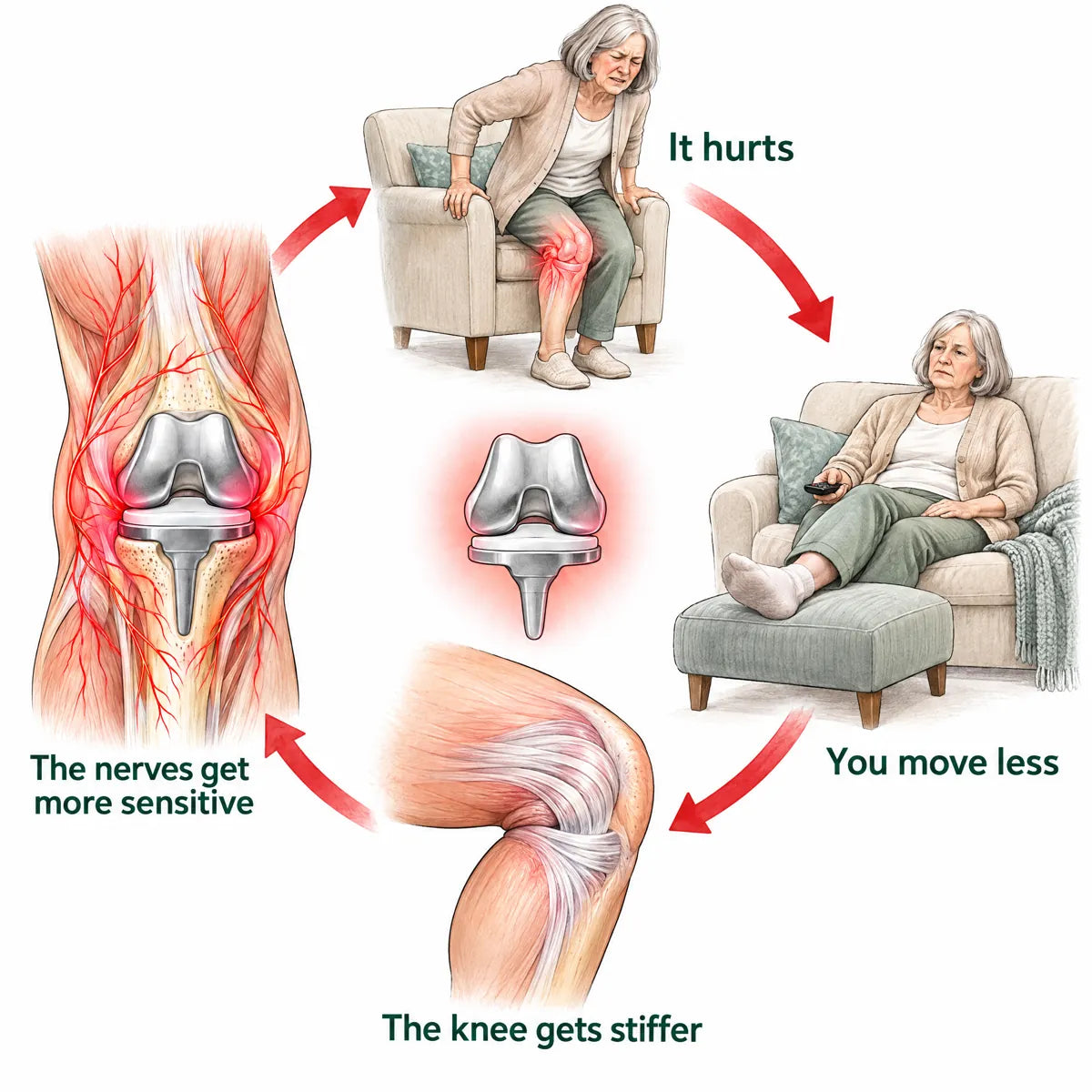
Every Time It Hurts, You Move Less. And That Makes It Worse.
It hurts when you stand up or bend, so you start protecting the knee. You push up with your arms. You pick the high chair. You stop getting down on the floor. Your other knee does all the work.
But a knee that moves less gets stiffer, and those nerves get even more sensitive. So the next bend hurts more, and the circle keeps tightening.
That's why "give it a year" doesn't work. And none of this is your fault.
The 60-Second Way To Quiet The Nerves
Remember the first days after surgery, while the nerve block was still working? No pain, and the knee bent far more easily. Quiet the nerves, and the knee moves.
Those nerves are an alarm stuck at full volume. Counter-Frequency Therapy sends gentle pulses straight into the exact spot that hurts and turns that volume down, right at the source.
The pain drops in about a minute. Do it daily, and the nerves stay quiet on their own. Less pain means you move more, and the knee bends better every week.
- Stand up and bend without bracing for the pain
- Take the stairs, even going down
- Kneel again, and get back up on your own
- Sleep without the 3am burning
That's what Pointex™ was built to do.

"I Tried TENS. It Didn't Work." This Isn't TENS Pads.
Pads spread a weak current over a wide patch of skin. The nerves firing hardest sit deep against the implant and barely get any of it.
Pointex™ concentrates everything into two small tips, pressed right on the spot that's firing. 60 seconds. A steady tapping, not pain. No pads, no wires.

Safe Around Your Implant. Not Too Late, Even 10+ Years Later.
It works on the nerve endings in the soft tissue, not on the metal. It uses FDA-cleared TENS technology, studied in 380+ randomized controlled trials, including on people with knee replacements.
6 months or 15 years ago, one knee or both, those nerves can still settle. But the longer they stay stuck, the deeper the pattern sets.

10,000+ People Stopped Accepting The Pain. Try It Risk-Free For 90 Days.
If your knee doesn’t feel better, send it back and pay nothing.

"My surgeon said the X-ray was perfect. But I couldn't kneel without that broken-glass feeling. Six weeks with Pointex and I knelt in the garden for the first time in two years."

"Eight months on pain medication after my replacement. Three weeks with Pointex and I get in and out of the car without planning every movement. I'm off the medication now."

"The tightness around the implant kept me up at night. Pointex was the first thing that actually addressed what I was feeling instead of telling me to wait."
Three weeks from now you could stand up from the table without bracing, sleep through the night and kneel on the floor with your granddaughter. Then get back up on your own.
Or keep waiting for "time" to fix it.
You didn't go through surgery to trade one kind of pain for another.

UP TO 62% OFF FOR A LIMITED TIME
- Pointex™ Pain Relief Pen
- FREE Post-Surgical Recovery Guide
- 90-Day Money-Back Guarantee
- FREE Shipping